Our stories are not etched in stone. Myth is not a fixed artifact. They are not fossils locked in time or preserved behind glass.
Nor should they be.
Myth, more language than history, is a living thing. It breathes through retelling, shifts with culture, and reshapes itself to reflect the fears, values, and questions of the people who carry it forward.
The story of Medusa makes this visible.
In earlier Greek traditions, Medusa and her sisters are born as Gorgons, daughters of ancient sea deities. They are not cursed. They simply are. Monstrous, powerful, and part of the world’s natural order. There is no moral lesson embedded in their existence. They occupy the mythic landscape the way storms or oceans do: dangerous, inevitable, and beyond judgment.
Then the story changes.
In the Roman retelling by Ovid, Medusa becomes something else entirely. She is no longer born a monster. She is transformed into one. A beautiful woman violated by Poseidon and punished by Athena, her body becomes the site of consequence. The myth shifts from a description of a creature to a narrative about power, control, and punishment.
Nothing about Medusa herself changes. What changes is the culture telling the story.
This is the nature of myth. It evolves not because the past is uncertain, but because the present is. Each generation reshapes myth to ask its own questions. Why does power punish the vulnerable? What does it mean to survive violation? Who gets to be called a monster?
In modern interpretations, Medusa shifts again. No longer just victim or villain, she becomes a symbol of protection, rage, and reclamation. Her gaze, once framed as a curse, is retold as a boundary, a warning, a refusal.
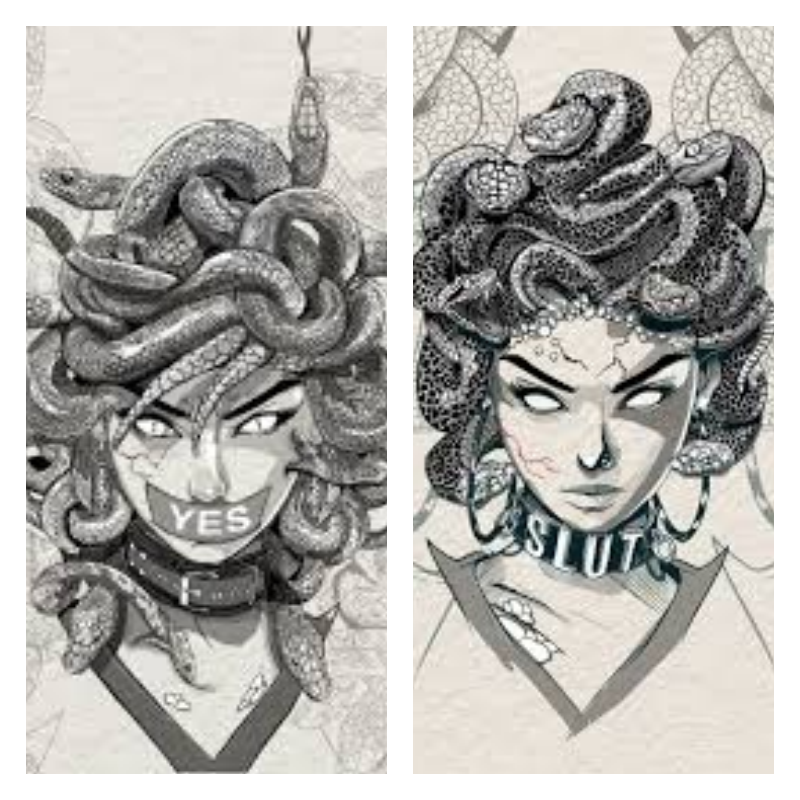
The myth is still alive.
Rather than static truths handed down intact, myths are conversations across time. Each retelling is not a distortion, but a continuation. Myth survives because it adapts. It remains relevant, not because it is unfinished, but because it cannot be finished.
Medusa has never been just one thing. She has always been exactly what the moment needed her to be.
When our stories stop moving, when they are treated as fixed, when they become etched in stone, they cease to be myth and become dogma.
Dogma doesn’t simply trap. It calcifies identity.
It locks us into the cultural beliefs, assumptions, fears, and power structures of a past that no longer reflects who we are or who we are becoming.
Our stories must evolve. They must be questioned, reshaped, reinterpreted. Or we cease to.
How Did Luciano Garbati Reimagine Medusa? – Written by Lea Stanković, MA Art History. Published: Sep 21, 2024
Note on the Featured Art: Hypo vs Hyper. Two reactions, two versions.
I recently discovered the meaning of the Medusa tattoo… It broke my heart, as I can relate… and still struggle to this day…
There’s no “right” way to survive what we never asked for…. Some shut down, Some lit up like fire, Some are trapped between… All are valid.
 The Cyrenaian Hedonic church
Leave a comment